
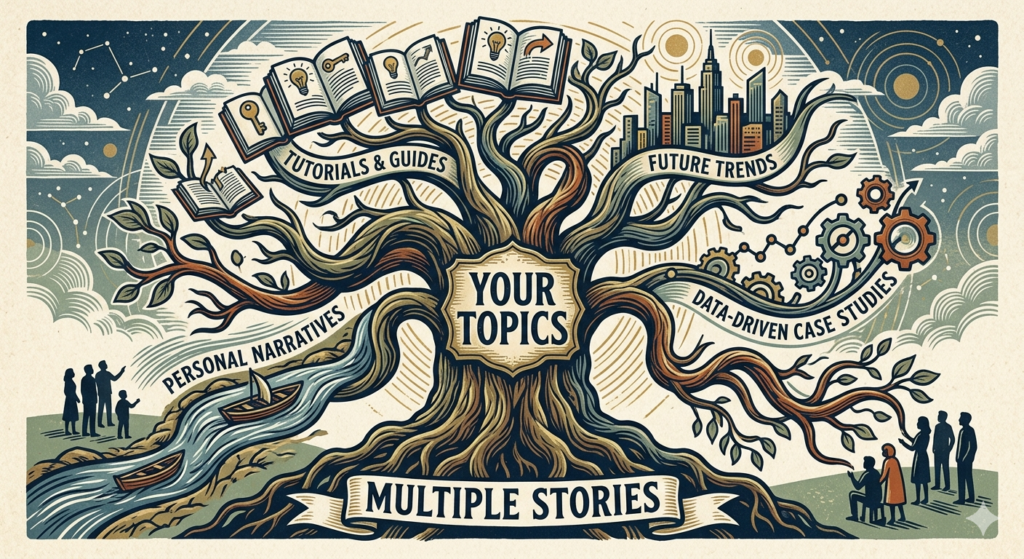
The biggest challenge isn’t just finding something to say—it’s finding enough ways to say it to keep your audience coming back. This is where the concept of Your Topics | Multiple Stories becomes a game-changer for your SEO and engagement strategy.
By taking a single core pillar and branching it out into diverse narratives, you don’t just fill a content calendar; you build a topical authority that search engines crave and readers trust.
The Philosophy of Your Topics | Multiple Stories
At its core, Your Topics | Multiple Stories is about maximizing the “yield” of your expertise. A “Topic” is a broad subject area you own, while “Multiple Stories” are the various lenses through which you view that subject.
Think of your topic as a diamond. If you only look at it from the front, you miss the brilliance of the other facets. To truly dominate a niche, you must show every angle.
Why This Approach Wins in 2026
-
Semantic SEO: Search engines no longer look for keyword density; they look for topical coverage. Discussing a subject through various stories naturally incorporates synonyms and related concepts ($LSI$ keywords).
-
Audience Segmentation: Not every reader learns the same way. Some want data-driven case studies, while others want emotional “behind-the-scenes” narratives.
-
Content Longevity: It prevents “content burnout.” Instead of struggling for new ideas, you simply find a new story to tell about an existing topic.
Step 1: Defining “Your Topics” (The Pillars)
Before you can tell a story, you need a stage. Your topics should be the foundational pillars of your brand. If you are a digital nomad, your topics might be:
-
Remote Work Productivity
-
Budget Travel Logistics
-
Mental Health on the Road
Each of these is a broad “bucket.” However, a blog post titled “How to Work Remotely” is too generic to rank well or engage deeply. This is where the transition to Multiple Stories begins.
Step 2: Extracting “Multiple Stories” from One Topic
To implement the Your Topics | Multiple Stories framework, you must look for the narrative arcs within your pillars. Let’s take the topic of “Remote Work Productivity” and break it down into different story types:
1. The “Data-Driven” Story
Focus on the numbers.
-
Example: “I Tracked My Productivity for 30 Days in 5 Different Time Zones—Here’s What Happened.”
-
SEO Benefit: Targets “productivity stats” and “remote work data” keywords.
2. The “Human Failure” Story
Focus on relatability and lessons learned.
-
Example: “Why My First Six Months of Remote Work Almost Ruined My Career (And How I Fixed It).”
-
SEO Benefit: High click-through rate (CTR) due to the emotional hook.
3. The “Technical Tutorial” Story
Focus on the “how-to” and specific tools.
-
Example: “My Exact Asana Workflow for Managing 10 Global Clients.”
-
SEO Benefit: Captures high-intent searchers looking for specific solutions.
4. The “Future Trend” Story
Focus on thought leadership.
-
Example: “Why Synchronous Meetings Will Be Obsolete by 2030.”
-
SEO Benefit: Positions you as an authority in the “future of work” niche.
Maximizing the SEO Impact of Your Narrative
Using the Your Topics | Multiple Stories model allows you to build a powerful “Topic Cluster.”
| Story Type | Internal Linking Strategy | Key Metric |
| The Pillar Post | Links out to all “Multiple Stories.” | Domain Authority |
| The Case Study | Links back to the Product/Service page. | Conversions |
| The Opinion Piece | Links to the Pillar Post to build context. | Time on Page |
By interlinking these stories, you tell Google’s crawlers: “I am not just writing about this topic once; I am an exhaustive resource on every aspect of it.”
Content Distribution: One Topic, Many Mediums
The Your Topics | Multiple Stories strategy isn’t limited to long-form blog posts. You should adapt these stories across different platforms to maximize reach:
-
Short-Form Video: Turn your “Failure Story” into a 60-second “Lesson of the Day” on TikTok or Reels.
-
Newsletters: Use the “Future Trend” story to spark a conversation with your email subscribers.
-
Infographics: Turn your “Data-Driven” story into a shareable chart for Pinterest and LinkedIn.
Common Pitfalls to Avoid
Even with a great framework, it’s easy to lose your way. Keep these three things in mind:
-
Don’t Cannibalize Your Keywords: Ensure that while your stories share a topic, they target different specific keywords. If Story A and Story B are too similar, they will fight each other in search rankings.
-
Maintain Brand Voice: The “Multiple Stories” should feel like they are coming from the same person. Whether the story is funny or serious, the core values of your brand must remain the constant.
-
Quality Over Quantity: Don’t tell a story just for the sake of it. If the story doesn’t provide value to the reader or support the core topic, leave it out.
Conclusion: Start Telling Your Stories
The Your Topics | Multiple Stories approach is more than just an SEO tactic; it’s a way to build a meaningful relationship with your audience. It moves your content from being a commodity to being a destination.
Stop looking for “new” topics every week. Instead, look deeper into the topics you already know. There are a dozen stories hidden in your expertise—it’s time to start telling them.
Final Thought: Every great brand is just a collection of well-told stories centered around a few key ideas. What will your next story be?